Friday, November 11, 2016

The Art of Not Listening

(Note: Part of the beginning of this blog is deliberately facetious for dramatic effect. Please continue reading even if the words are uncomfortable to read. There is a purpose behind the words.)

We must never forget what happened on 11/8...

Very much in the way that 9/11 symbolizes fear, anger, and resentment to many Americans, 11/8 is the new calendar date to evoke feelings of fear, anger, and resentment.

As soon as Hillary Clinton conceded the election to Donald Trump, the Internet has been an interesting place to observe the lesser qualities of human behavior.

We all know that posting online, such as on Reddit or Twitter or Facebook, about sensitive subjects gives people a false bravado, and we see many hateful things written online insulting people, threatening people, and dismissing people as well as their opinions. This is not the exclusive club of one ideology, but every ideology.

The Internet creates hate in its ability to offer safe refuge for the hater.

How to Be a Proper Political Troll

Don't like something someone said? If you insult their mother, you will get away with it. No one will reach out and punch you in the nose. So, if you can deal with "the opposition's" best counter attacks, you are golden. You can continue a stream of hateful tweets and Reddit posts, and you can remain safely and comfortably...  anonymous.

The key to attaining this anti-Zen state of hate-filled anonymity is to ignore the person writing to you completely. They are not human beings, for they are the opposition and must be crushed. They are not WITH you, nor are they worthy of your respect. They are against you, and that means you can unload every nasty word, phrase, and sentence onto them without any remorse or guilt.

After all, they deserve your wrath.

Not listening is the essential part of attaining this anti-Zen state. You must not empathize with your ideological opponent. But what is critical is that you must use every ounce of your mind's vast capabilities to take whatever they say and use it against them like a text version of Judo. Use their own power to defeat them. Mock them with insulting images. Make them feel small. Make them cry. And a bonus... Make them commit suicide. That is when you know you have truly WON.

(Facetiousness OFF.)

That is what happens online with two people who have opposing views. It always happens. Disagreement turns to anger which turns to hatred which ultimately turns to death, either by suicide, retaliation, or some other form.

Only Reddit pages that are strictly moderated have anything resembling a true dialogue online. Without moderation, the Internet is like the Wild West where the bad guys can kill anyone they choose and the townsfolk are too scared to stand up for themselves.

Where is this country's online Yul Brenner? Where is OUR Magnificent Seven? Where is OUR Seven Samurai to defend us from the oppositional horde?

Nowhere to be found.

We have seen this so many times on various online sites that we have begun to take this attitude to real life, not listening to people in campus protests, on TV news segments, on talk radio programs, in our fairs and town squares and barber shops.

That is the situation we fave now after the Presidential election. At the time of this writing, people are gathering in multiple cities around the country to protest the election of a man they feel is a danger to their lives, to the lives of their family members, to their children's lives, as well as to countless friends.

The Black community, the Hispanic community, the LGBT community, the Muslim community, feminists, the sexually abused, the physically disabled, and many more groups who feel marginalized by a simple vote, are all scared that they will be hurt by our new  government and by what our future President has promised in his campaign.

We have not been so close to chaos since the Sixties, and no one is listening to each other. No one did then either, but now we have social media to spread our discontent onto the computers and phones of potentially millions of people.

This "not listening" bullshit is going to kill us. I'm not even joking about this. We need something to stop us from destroying each other. Protestors will die. Police officers will die. All if we don't change course. And that means LISTENING to the opposition.

We need a countrywide group therapy session where everyone remains calm, no one gets angry, everyone uses their indoor voices, and everyone gets a chance to speak ONLY if everyone spends 99% of their time LISTENING, and not interjecting every two seconds and saying, "Wrong!"

(sigh) The only way I can know how to treat you is by empathizing with you, and you empathizing with me. Empathy is a strange but wonderful process where you begin to feel how another person feels, where you understand why someone reacts the way they do, and why sometimes people get angry and want to destroy things.

Only empathy can lead to the understanding of why a 50 year old white male in Arkansas, who is not racist or misogynistic, preferred a man with no political experience to the woman who was vastly more qualified. Only empathy can lead to understanding why Clinton supporters were shocked and dismayed by a Trump election win and why they believed that Clinton was the clear choice for them.

If we don't listen to each other, we are dead. Imagine it. Imagine Trump supporters trying to quell the protests with guns, someone gets shot, then the protesters bring guns and more people get shot, until the National Guard is called in and now we have the Kent State shootings times 1000, and everybody rallies around their slogans and their songs and their mantras until we are fighting our second civil war.

Think that's far-fetched? Think that's a Chicken Little observation? A civil war is the next big leap from where we are today. Clinton supporters and Trump haters are currently protesting, and Trump supporters are expressing their mockery and misunderstanding of the reasons behind the protests.

No respect and no empathy means no listening, and that means no solutions and no peace.

Wake up, America. You thought the election was over. Trump may have won, and he may be our rightful next President, but enough people were shocked about it that it has destabilized common discourse. People would rather use the broad brush to label you. Don't let them.

Strive for calm. Strive to listen. Strive to understand, and never preach. Use empathy to understand each other, and we may get through this with limited bloodshed.

Thanks for reading this. Feel free to include any empathetic comments below. I would love to read them. Thanks.

Thursday, October 20, 2016

The End of an Election (or a Country?)

If you sift through my blog here, you won't find many posts on politics. In the past 10 or 15 years, my interest in talking politics was similar to my interest in taking a ball-peen hammer and striking my forehead with it. So, what makes it different now?

Simple. Donald Trump.

It's difficult to remember a time when Donald Trump was not irritating us in the news. But to me, the mere thought of him running for POTUS was as realistic as Darth Vader declaring his candidacy. That's right. I give Trump the same respect as I give a fictional character in a sci-fi film.

But to my surprise, Trump did declare his candidacy, and back in the late summer of 2015, when Trump was holding rallies, my friends were getting nervous. I tried to reassure them that the primaries were months away, and by that time, the real political machines will be under way and Trump will be laughed out of the race before March 2016.

Well, as we all know, that never happened. The anxiety that my friends had that summer in 2015 about a Donald Trump candidacy was now something I felt myself. I fully expected Trump to be laughed off the stages of his rallies, but he surprised us all by defying every political predictor and convention.

Trump seemed to get away with everything, too. Call Mexican immigrants "rapists?" His poll numbers go up. Make fun of a disabled man? He dodges the heat. Call woman "pigs," "dogs," and "ugly?" His supporters are right there cheering him on. The level of this man's disregard for huge swaths of our population has been staggering to witness. And yet, at no point did it seem to affect his popularity.

That is, until the first debate with Hillary Clinton. He had a good twenty minutes before Hillary was able to pull him off-message and get him irritated. Hillary was so loose during that debate that when Donald finished a particularly scathing attack on her, she smiled. did a little shimmy, and said "Okay!" showing her eagerness to battle with Donald in debate.

Clinton won that debate because Trump simply did not prepare. Furthermore, Hillary was prepared for anything Donald could throw at her. But since Donald reverted to the debate version of a boxer wildly flailing his gloves in a windmill fashion, hoping to connect with something, Hillary was the precision boxer, tagging Donald here, tagging him there, and slowly and surely accumulating the points she needed to win.

Then, a few days before the second debate, there was the infamous leak of a 2005 video where Donald Trump and Access Hollywood co-host, Billy Bush, are heard making lascivious comments about women. Of all the bombshells in the campaign, this one hurt Trump the most and caused a drop in the polls. He made a low-quality video apology, which pundits say was more of a non-apology. He knew that this would be a question asked of him during the next debate.

The second debate was, arguably, a debate more suited to Hillary Clinton than to Donald Trump because it was a town hall format where a select number of undecided voters were selected to ask questions just a few feet away from the candidates. Hillary is very comfortable in town hall settings, but Donald seems to have trouble relating to the common American.

Almost from the start, Donald started doing something never seen in town hall debates before. He started stalking Hillary Clinton on the stage.

On several occasions, while Hillary was facing a questioner and offering an answer, Donald would walk over from behind her and stand just a few feet away like a serial killer about to pounce.

One wonders if Trump thought this was some kind of intimidating effort, but as a TV viewer, it looked more creepy than commanding. Also, when pressed on Trump's comments on the Access Hollywood video, Donald dismissed them, claimed he was a different man, and left it there. Clinton hammered him on this point, which is one of the reasons that Clinton won that debate, as well.

Then, the final debate was staged at UNLV. This would be a repeat of the first debate format, so in the minds of some pundits, all Hillary had to do was not screw up and she'd do well. For Trump, his steady decline in national poll numbers meant that he needed to win this debate decisively.

This was even more contentious than the first debate. Donald called Hillary a "criminal" for the Benghazi situation, called her "a nasty woman," while Hillary called Donald a puppet of the Putin regime in Russia. This was the first debate where the candidates did not shake hands before or after the debate, which is unprecedented in American political debates.

As with the first debate, Donald stuck to the issues for about 45 minutes and did well keeping to the issues before Hillary started rattling him with comments.

Donald failed on several opportunities to nail Hillary on some key points because he focused too much on defending himself from Hillary's accusations. This was exactly what Hillary wanted, and Trump was yet again pushed off-message. After the debate, early polls gave Hillary Clinton a clear debate win over Donald Trump by 11 points.

So now, we have the election in about two and a half weeks. Clinton supporters should be feeling good, but Trump has been seeding the clouds of discontent by claiming the election will be rigged and stolen from him.

One of Hillary's best moments un that last debate was when she detailed how often Donald blamed things that don't go his way on rigged systems. She even mentioned how after he did not win an Emmy for a season of The Apprentice, he tweeted that The Emmys were rigged. Instead of keeping his mouth shut, Donald remarked, "Should've gotten it."

But the biggest bomb to drop was moderator Chris Wallace's question to Donald Trump on whether or not he would honor the will of the people and accept the results of the election even if it did not go his way. Trump refused to say he would accept the election results.

This is not only unprecedented. It is bordering on treasonous. In a vain attempt to give himself an excuse if he loses (so it appears that it was not his fault,) he is calling into question the very foundation of our democracy. He is also communicating a strange message to his followers. After all, if the system is rigged like Trump claims it is, why would a Trump supporter vote at all? This is no incentive to vote, but a discouragement.

It is a tradition for every candidate to humbly and graciously accept the election results and concede the election to the victor. Trump says he'll keep us "in suspense," as if this was a cliffhanger on a TV show. He acts like this is his personal reality show and it's all done to enhance his brand.

(heavy sigh)

This election has been like watching a violent car crash every day for over a year. The driver of that car is Donald J. Trump. Unfortunately, if he wins the election on November 8th, Trump will be leaving the car and driving the country off a cliff.

It is horrifying to me that this cartoon character of a man has come this close to becoming the leader of the free world.

The only thing that gives me solace, or some kind of feeling that reason and intelligence may win the day on November 8th is that Hillary Clinton has a larger lead over Trump in key battleground states, making it very difficult (and maybe impossible) for him to gain the 270 electoral votes needed to win the race. At this point, something rather catastrophic would need to happen to give Trump the votes he needs, and we are only 16 days away.

16 days away from triumph or tragedy; exultation or immolation;

If you lasted this long, I do appreciate it. Let me know if you felt similar to me about Donald Trump in this election.

Take care!

Sunday, October 16, 2016

Comparison Between Donald Trump and Citizen Kane

Note: If you care to watch the Orson Welles film, "Citizen Kane," and you wish to avoid spoilers, come back and read this when you are ready.

The 1941 classic film, "Citizen Kane," might offer an interesting insight into the mind and obsession of Donald Trump.

In the film, Charles Foster Kane is a rich newspaper magnate in New York City who decides to run for Governor of New York State. In the film, Kane is caught in a love affair and is threatened with exposure if he does not drop out of the race. Kane refuses the threat and pushes on. The scandal is published and Kane loses the election.

A parallel between the film and reality occurs when Kane is faced with the decision to either drop out of the race or face the embarassment of his private affair becoming public. Kane says that the only person who can decide best what he should do is Kane himself. There is a stubbornness to Kane's refusal to back down. Stubbornness and pride get in the way of sense, because to Kane, nothing can stop him from winning the election no matter what is printed about him. In the film, this turns out to be false.

The film's character echoes Donald Trump a bit because, after the vulgar and salacious 2005 Access Hollywood recording of Trump and Billy Bush was released, rather than give up, Trump doubled down on his rhetoric, much like the fictional Kane, attacking Clinton with everything he had in him, refusing to admit defeat, and vowing to a never give up.

One wonders if the same stubbornness shown by Charles Foster Kane runs through the veins of Donald J. Trump. We have yet to see the results of the election to see if Trump's strategy is a success or not.

Another similarity is Kane's absolute confidence in everything he does. He loses an election? Kane prints in his newspaper that the election was a fraud.

Trump, in the last few weeks, has been dropping in the polls, and as a reaction to this, he is seeding the clouds of discontent by publicly claiming that if Clinton should win, it will be due to the election being rigged.

Trump and Kane cannot accept defeat. When defeat is looming, they both act in the same way. It's someone else's fault. It's not a personal or professional failing, but a failing of the system or some other scapegoat.

Charles Foster Kane is never shown talking crudely about women, and in fact, he is shown to have a very human side, despite his one example of philandering.

Trump, on the other hand, has bragged of his many "conquests," and even now, as a growing number of women come forward to accuse Trump of inappropriate sexual contact, Trump's main comment is to belittle the women as "ugly," saying he would never do anything with women so "unattractive." (As if to actually admit that if they fit his skewed definition of "attractive," he'd definitely do something to them.)

Kane is never portrayed in such a light. Sure, he lives a tragic life, one without love, and he is ever searching for something only he understands. But Kane's story is one of the well-worn "rise and fall" plot. With Trump, the plot has no end, but it is fascinating to see how two characters; one fictional and one real, cross each other.

It will be interesting to see how Donald Trump handles defeat. If he follows the Charles Foster Kane pathway, Trump will go into exile somewhere, build a mighty palace, and hide from the prying eyes of the world, and die in obscurity.

We should only be so lucky.

(Since writing this article, I found this AV Club blog where it shows that Citizen Kane is Donald Trump's favorite movie. I guess Kane's like is the only one that Trump can relate to. http://www.avclub.com/article/citizen-trump-what-donalds-love-citizen-kane-revea-232301 )

Saturday, October 15, 2016

Why Voting Matters

You might remember the year 2000, or as pre-Millenials used to call "Y2K." This was an election year. Democrat Al Gore was leading in electoral votes going into Florida, where Republican George W. Bush lead the state's returns by a mere 537 votes.

Think about that. 537 votes was the difference between Gore and Buch

A controversy behind "hanging chads" on ballots forced Gore to request a recount, and that decision went all the way to the US Supreme Court, who halted the recount, effectively handing the election to Bush.

Now, whatever your personal politics may be, 537 votes is a scary narrow margin. That is less than the daily number of customers to the nearest McDonald's.

I'm not going to tell you how to vote. That is your business, but I urge you to vote for the President you want, the local legislators you want, and the local Propositions you support.

There is no excuse to be idle in 2016. This country is on a precipice of political upheaval, and your vote could mean the difference between four years of an administration you despise, or one who will lead to growth, strength, compassion, and leadership.

Don't refuse to vote this year. Make your voice heard. Make your vote count. Maybe this year, the difference between the winner and loser will be less than 537.

Whatever you do, please vote. Be a part of this democratic process. It's what makes us Americans.

Saturday, April 9, 2016

Those Aren't The Fanboys We're Looking For


"It's MY ball, and if you don't play by MY rules, I'm taking my ball and going home!" (pout)

This is an exaggerated phrase I have heard in my childhood a few times, usually uttered by a kid who brought the ball that the neighborhood kids used to play a sport. It was heard mostly when the kid with the ball was on a team that was losing and doesn't know how to deal with that feeling of momentary failure except to grab his ball and go home angry.

I mention this because I have seen a variation of this childish mentality among a certain segment of movie nerd culture. Namely, from some very vocal men.


The most recent spate of male irritation began with "Mad Max: Fury Road," where some decried the movie for being a "feminist" bastardization of the Mad Max franchise. The notion comes from the story, which pits Imperator Furiosa, a strong female warrior of the wastelands played by Charlize Theron, against an armada of apocalyptic baddies in the desert all trying to re-capture the concubines Furiosa freed from an evil despot. Max, it is argued by the anti-feminists, has been reduced to a minor character in the film and even (GASP) takes orders from Furiosa. Max has almost no lines, whereas Furiosa has the lion's share of dialogue. They claim that Max has been neutered in the script to be a pawn to a "feminist" agenda.

(sigh)


Next, some men accused "Star Wars: The Force Awakens" to be another movie with a "feminist" agenda. Why? Apparently, some men are uncomfortable with anyone but a male in the lead actor's position.

Rey, the film's capable protagonist, may or may not be a Mary Sue, (a character written without any flaws who is mostly wish-fulfillment for the author than a fully formed character,) but there are tons of Mary Sue characters as men, often called Gary Stu. (Pre-Daniel Craig "James Bond," anyone? Captain freaking America, anyone?)

Also, the fact that there are men who bristled at following a capable female as the lead character in a Star Wars films says more about the men criticizing it than it does about the character. Doesn't it? Who didn't adore watching Rey and Finn escape Jakku and giddily recount their amazement at doing so? It was what all of us would have felt in that moment. But for some, it's illegitimate because a female is the hero, not the male, and for them, only MEN can lead. Those who care about the gender politics of a space fantasy film must have been angry beyond words.


Now, we have the new Star Wars stand-alone film, "Rogue One," which has just released a teaser trailer. In the teaser, we are introduced to a young woman named Jyn Erso, played by Felicity Jones (above photo.) She is under arrest, we presume, as the Rebel Leader, Mon Mothma reads off the detained prisoner's crimes. The woman responds by saying, "This is the Rebellion, isn't it?... I rebel." Badass, right? Well, apparently not for some men who have already tagged the film as another movie with a "feminist" agenda, mockingly using the SJW tag which stands for "social justice warrior," and decrying the fact that YET ANOTHER movie is giving us a female lead.

Katniss of "Hunger Games," Tris from "Divergent," Furiosa from "Mad Max: Fury Road," a female Thor in the comics... All part of the "feminist" agenda, according to some men on the Twittersphere.

Watch the "Rogue One" teaser to see the feminist agenda at work... You might have to squint your eyes during the trailer as it's a"blink-or-you'll-miss-it" moment. See the video below, and watch for the outrageous "feminist agenda" of "Rogue One: A Star Wars Story."


Did you see the "feminist" agenda anywhere? No? That's because there is no agenda.

Okay. Enough tip-toeing around the topic. It's time for me to offer my take on this. I find the allegation that the above-mentioned films are part of some kind of Hollywood effort to eliminate men as the main characters of films as patently preposterous. (Yes, this is an opinion cited occasionally by anti-feminists.)

First off, what the hell is wrong with a female protagonist? Nothing. What was wrong with Ripley in the Alien films? Who would have a problem with Sarah Connor in T2? You wouldn't, unless you have gender issues with women, that is. Female moviegoers have been dealing with male heroes in movies since movies began. It's about time we get some strong, kick-ass, intelligent women in our genre movies. Why should gender have anything to do with heroism? Secondly, fans of all political opinions flocked to watch The Force Awakens film, and critics almost universally accepted Rey as an intriguing part of the Star Wars universe. Where is the agenda?

I believe that this spate of female protagonists is a good thing. No... It's a great thing. For many, many years, sci-fi and fantasy was a males-only club, and the men liked it that way. Male writers wrote for boys and female writers wrote for girls, and never the twain shall meet. Both readers and the writers were men, and women were encouraged to read romances, or nothing at all. Read the accounts of female sci-fi authors of the 1950s and 1960s, and you will see that there was an active effort to discourage women writers from having careers along-side the sci-fi writing luminaries of the day. This mimicked the discouragement women faced in all areas of employment in the 20th Century.

However, women like DC Fontana, Ursula K. Le Guin, Madeleine L'Engle, C.J. Cherryh, Anne McCaffrey, Mercedes Lackey, and others, fought the notion that sci-fi and fantasy is a "males-only" club. They busted down the myth that women can't write a good sci-fi/fantasy story. But despite their fight to be heard amid the flood of male-oriented stories, some males still think to this very day that women don't belong.

Women and young girls face condescending stares, harassment, and inappropriate assumptions to this day at computer gaming events, board gaming events, comic book stores, etc. Do a search for "girls aren't gamers," and the results will depress you. Young girls are constantly doubted, questioned, marginalized, and ordered to prove themselves to men that they are truly fans of the things they love.

As a male, I have never had to prove myself to anyone, and neither should any girl have to prove to me or anyone else that she loves anime, Batman, boardgaming, Walking Dead comics, DOTA 2, or anything else.

Bottom line is if you are the type of person who feels that women deserve an equal opportunity as moviegoers, heros, actors, writers, directors, producers, CEOs, and human beings, then you are on the right side of this debate.

It is time to stop the anti-feminists rhetoric and call people out for their gender biases. Women deserve to be fans. Women deserve to be leaders. Women deserve everything a man deserves for their hard work. 

Why is this so hard for some people to understand?


Friday, February 12, 2016

Movie Review: Deadpool (Minor Spoilers)


Origins of a Movie Merc

"Deadpool," starring Ryan Reynolds as the "Merc With a Mouth," is a project that has been years in the making. This is Reynolds's second shot at Deadpool, since his first shot at playing the immortal, psychopathic mercenary, was in the 2009 film, "X-Men Origins: Wolverine." However, the realization of that film's character was an extreme disappointment to Deadpool fans, as it changed his back-story, and changed his entire look. Back then, due to this great disappointment, everyone feared that a Deadpool solo feature would never be made. And for five long years, fans would have to wait.

The "Leaked" Deadpool Video

Then, in 2014, a six-minute, "proof of concept" video was "leaked" onto the Internet (possibly by Ryan Reynolds himself,) featuring an exciting action sequence, along with Ryan Reynolds' voice talent. The video was apparently made by an effects company to prove that a Deadpool film can work, in the hopes that 20th Century Fox, who owned the film rights, would green-light a Deadpool film. Reynolds voiced the character in the same profane, violent, and extremely funny character that comic book fans have come to know and love, and it made the collective internet soil its Underoos with joy. If only, they all sobbed, the powers-that-be would understand that an R-rated Deadpool movie would actually make money, then maybe this film would get made.


Shortly after fanboys and fangirls lost their collective minds over this "leaked" footage, 20th Century Fox green-lit the film to every fan's delight. The thought among comic book aficionados was that this was Ryan Reynolds' opportunity to do two things: 1) Redeem himself for bad superhero movies, such as "Blade III," the Wolverine film, and especially, "Green Lantern." Ryan seemed to be liked as Deadpool, and only as Deadpool. So, this was his chance to shine. And 2) Deadpool fans could finally see a true-to-the-comic version of the Deadpool character, in live-action onscreen. 

So, Is It Any Good?

YES. It is a solid hit! (Someone please blurb me. BLURB ME!) "Deadpool" is a lean, mean one-hour and forty-eight minute assault on the senses and the funny bone, and it barely lets you rest before the next joke or action sequence. Even the opening credits are hilarious, providing one of the most inventive openings in modern superhero cinema, where the cast is described in a very unorthodox way. This is a movie that you must pay attention to or you will miss many a joke.

Okay. What's It About?

The film follows a Canadian mercenary for hire, named Wade Wilson, whose main source of revenue appears to be intimidating young men into not harassing females on a college campus. We see that he's not the most scrupulous man, and that he has killed people in combat, but he's also not working for the mob, either. So, points for Wade? Then, he meets Vanessa, a prostitute with a heart for bad-ass mercenaries named "Wade Wilson," and they have a storybook romance.

What? Is This a Rom-Com?

No, you annoying sub-heading. This is not a rom-com, so reality hits back at Wade and hits him hard with a cancer diagnosis. Quite honestly, there was a moment in the doctor's office where Wade is deep in thought, and this reviewer actually had a tear in his eye for a moment. 

Coincidentally, (or not,) Wade meets a man in a suit who offers to make Wade "better than better," and thus begins Wade's attempt to cure himself of his cancer, which, of course, goes horribly wrong, leaving Wade's skin horrifically disfigured, but with an unlimited healing factor. Yes. That means Wade is a physically scarred, immortal man. He cannot be killed. But being a horribly disfigured man means he cannot show himself to his main squeeze, Vanessa, who he left to be on her own in order to get the "treatment." Now, Wade seeks the man who gave him the treatment in order to force him to restore his previous good looks, He makes a suit, kills a bunch of people for information, and his pathway is cleared to finish the treatment, and kill all the bad guys in the end.

Why Is He Talking Directly To Me?

Fans of the comic know that Deadpool has always known that he is a fictitious character. It was Marvel's way to send up the superhero genre with a self-reverential comic book character who broke the "fourth wall" and talked straight to the reader. In this film, Deadpool knows that he's a character in a movie, and he frequently talks to the audience. In one scene, he's talking to the camera, but when another character answers him, Deadpool says he wasn't talking to him, but to us, the moviegoers. This is just one of the more fun aspects of the movie. At any point, the movie seems to take a complete u-turn, or it goes on a hilarious tangent that references some inside joke only the audience is in on.

Is It Violent and Sexual?

Yes, and YES. Hoo hoo boy, is it ever! The movie is chock full of gun-play, and while there is blood, it's almost cartoonish in its outlandishness, and not nearly as disgusting as an R-rating would have you believe. (Unless you get squeamish at the sight of any blood on screen, I think you'll be fine.) There is male and female nudity, and a couple tastefully shot sex scenes. The language is definitely more adult, and the jokes are mostly of a sexual nature. I fully expected more potty humor, but it seemed to stick with more sex-themed humor.

Is The Plot Thin?

The plot is sparse and uncomplicated, but that's a good thing. The movie is boiled down to this: Boy meets girl. Boy gets cancer. Boy leaves girl to get cancer cure. Boy's cancer cure severely disfigures him. Girl is kidnapped by bad guy. Boy must kill a mountain of people to battle for the love of his life.

That about sums up the plot. The jewel in the "Deadpool" crown is its complete reveling in its profanity and violence, like kids playing on the most awesome playground. You can tell that Ryan Reynolds is having a ball playing Deadpool, and it's easily his best superhero turn, even if Deadpool isn't exactly a superhero. He's an anti-hero who is amoral enough to not mind killing anyone to save his girl. Also, Deadpool gets some help from two members of a certain school for mutants, namely Colossus, and "Negasonic Teenage Warhead," who is as bad-ass as the name implies. She deserves way more screen time in the future.

Alright. So, Boil It Down For Me.

This is a thoroughly enjoyable, adult romp into a unique, blood-splattered world inhabited by an entertaining, motor-mouth, immortal mercenary whose humor is as relentless as his killing skills. It will please practically any Deadpool fan.

This movie is rated R, for language, adult situations, graphic nudity, and graphic violence, although I must say that I have seen movies where the violence is much more graphic, and the nudity much more pervasive. Nonetheless, be forewarned that this is an adult movie, and judge accordingly whether your kids are mature enough for this movie.    

Sounds Good. Is There a Marvel Post-Credits Scene?

Yes, and you must not miss it. Older moviegoers will understand the scene more than younger fans, but it's hilarious and informative, nonetheless.

Friday, December 18, 2015

Movie Review: Star Wars: The Force Awakens (NO MAJOR SPOILERS)


Note: I have pulled back severely from what I would normally reveal in this review because I know that people dislike Star Wars spoilers. Unfortunately, it is impossible to do a proper movie review without revealing some of the plot and characters, so enter with caution. I think I've written about the most un-spoilery review I could possibly manage, so don't worry. As with any review, you must determine on your own how much you care to know about the movie's details before you go to see it.

(If you DO want spoilers, I will be posting a no-holds barred review and analysis later.) 

Here now is my short, non-spoilery review of "Star Wars: The Force Awakens." 
____________________________________

You can all relax. J.J. Abrams gave us the movie we all wanted to see. He gave us a great, entertaining film, complete with action, comedy, and even emotion. But several years ago, this all seemed very unlikely.

Back when J.J. Abrams was announced as the director of the first film in a brand new set of Star Wars films, there was a bit of skepticism in sci-fi fandom. After all, Abrams did oversee the reboot of another beloved sci-fi franchise, Star Trek, and some fans were none-too-pleased with the result. 

With Star Trek, Abrams effectively erased the past, making anything that happened in the TV shows or movies null and void. So, fans feared that Abrams would be doing the same with their beloved Star Wars.

Well, fear not, Star Warsians, because this has not happened. The new film, "Star Wars: The Force Awakens," is a robust and exciting, sci-fi fantasy film that honors the past while setting up a promising future for the franchise. 

In the film's classic opening crawl, we are told of the disappearance of an important figure and two factions who are seeking to learn this person's whereabouts. This sets the scene for the action to follow. Once the action commences, the pain and suffering begins.

For you see, there is a new group of bad guys who look really similar to the old bad guys. The new version of the Imperial Empire is the ruthless, First Order. They have a new dark lord, a new gaggle of fanatical officers, and a plan to wipe out all that is left of the Resistance, once and for all.

With a nod to the original Star Wars, much of the early action centers around a desert planet called Jakku, and a young female scavenger named Rey. She is self-sufficient, independent, and hard-working, but her work pays little, and her gaze occasionally drifts to the starships she sees leaving the planet. 

However, she comes across a lost droid named BB-8, a spherical robot with a head that always stays parallel to the ground as it rolls. Soon after, Rey meets a mysterious man named Finn, and before the three of them realize it, the First Order is trying to gun them all down. 

It seems that the droid possesses something that the First Order wants very badly. More importantly, one dark lord wants it very badly - a black masked, black cloaked figure named Kylo Ren. Ren is a Force-wielding killer, and he will stop at nothing to obtain what the droid is carrying. He also has an agenda that would make the late Emperor Palpatine very proud. 

If this feels somewhat familiar, that's half the point of this film. It is part nostalgia, part new adventure, and it all flows quite nicely with each other. We get to see old friends again, like Han Solo (Harrison Ford,) Chewbacca (Peter Mayhew,) Leia (Carrie Fisher,) and others. The addition of solid new characters like Rey (Daisy Ridley,) Finn (John Boyega,) and X-Wing pilot Poe Dameron (Oscar Isaac,) all feel like the franchise is heading in a very interesting, emotional direction similar to the original trilogy.

"Star Wars: The Force Awakens" has everything a die-hard Star Wars fan could possibly want. You'll care about the new characters just as we cared about the older ones when we first saw them, and that's crucial for the longevity of the series. The film has The Force, cool spaceships, big explosions, strange aliens, droids, interesting vehicles, lightsabers, surprises, intrigue... and it has "adventure and excitement." While a Jedi should not crave these things, Star Wars fans do, and J.J. Abrams successfully delivers to them a very worthy addition to the Star Wars universe that they will not be embarrassed to talk about 10 years from now.

Postscript: If you think this gives anything away, I can assure you that I have not mentioned hardly anything about this film. You can go to the theater safe in the knowledge that you have a starting point for an entertaining experience, but one that will still surprise and delight you.

Monday, March 2, 2015

Movie Review: Kingsman


Who doesn’t like a good spy film?

If you raised your hand (either figuratively or literally,) after reading that last sentence, then Kingsman: The Secret Service is definitely not for you. For the rest of us, Kingsman is both a highly charged and self-aware compliment to the spy films of past and present (not unlike the way Scream was a knowing compliment to all of the horror films it referenced,) while attempting to carve out its own small niche in the spy genre itself. 

In this humble reviewer’s opinion, the film achieves the former, but never achieves the latter.

Kingsman is a loose adaptation of a Mark Millar (Kick Ass) and Dave Gibbons (Watchman) comic book titled, The Secret Service that was first published in 2012. In this filmed version, Colin Firth plays Harry Hart, a covert operative whose protégé is killed in the line of duty. Harry later hands a medal of bravery to the son of his protégé along with a phone number and coded phrase if he or his mother ever needed assistance.

Seventeen years later, the boy, Garry “Eggsy” Unwin (played  by relative newcomer, Taron Egerton) is a young man without direction and living with his mother and her abusive boyfriend. Eggsy is arrested for stealing a car, and he uses his one phone call to dial the number on the back of the medal. After saying the code-phrase, Eggsy is immediately released from jail without explanation. Outside the police station, Eggsy meets Harry, the man who gave him the medal so long ago, and Eggsy soon discovers that his father was a part of a secret organization of spies called “Kingsmen,” and is offered an opportunity to become his new protégé.

What follows is a classic comic book origin story as we follow Eggsy’s training into the world of spies. While this happens, the Kingsmen are busy investigating a man named Valentine, played by the always amazing, Samuel L. Jackson, who might be responsible for a series of high-profile people suddenly disappearing around the globe. Soon, Harry Hart, Eggsy, and the Kingsmen must deal with a plot of worldwide significance that deals with the manipulation of technology for a nefarious end.

Kingsman: The Secret Service is a movie that is aware of the spy films that preceded it. It’s so reverential to these films that, in one scene, a character even names some of the most famous spies in popular culture as a none-too-subtle tip of the hat to the genre. This reverence for the genre is never far from our sight, as the winking and nodding almost becomes the point of the plot.

This is the film’s biggest flaw. Any movie that is constantly winking at us and saying “Did you catch that reference?” can get tiresome after a while and make us wonder when the film’s own unique voice will begin. 

Sadly, it never does. There is a point where the winking and the nudging goes on for a bit too long, and this reviewer wished it could have been toned down to allow for its own voice to shine through. It is one thing to be reverential of the spy genre, but entirely another to make that reverence a constant part of the story. It’s like the film constantly taps you on the shoulder to remind you of the genre it’s sending up, and that became a tedious and annoying reminder.

Since the nods to the spy genre never end, the film never really transcends the genre that it clearly loves, and thus, never succeeds in forging its own identity.

One cannot watch this film without drawing comparisons to Mark Millar’s previous comic book adaptation to film, Wanted, starring James McAvoy, Angelina Jolie, and Morgan Freeman. Wanted has the exact “normal-guy-joins-secret-society” plot as Kingsman, but with slight variations, and there is a sense that this has all been seen before many times.

Despite being the “wink-wink-nudge-nudge” fest that it is, Kingsman does deliver some really cool moments, including some awesome action sequences with Colin Firth. He dispatches foes with the style and ease of a man calmly pouring a cup of tea between trigger-pulls and knife-stabbings, making sure never to muss up his perfectly tailored, Savile Row suit in the process. The violence is fast and frequent, providing an appropriate amount of menace to the story. Yet, there are a few intentionally muted scenes that tone the violence down using a bit of surrealism, but make no mistake; it’s still an “R” rated film.

If you liked Wanted, you’ll probably find Kingsman to be a better film, but you will see the similarities immediately. If you love the spy genre, and you just want to sink back into that world as seen by some “super-fan” filmmakers, then Kingsman will entertain you, and it's definitely worth your time. However, if you want something that is wholly original, taking the spy genre into new levels of excitement and creativity, Kingsman will probably be a disappointment to you.

Saturday, February 28, 2015

Movie Review: Birdman


Many people suffer from “negative self-talk,” which is a critical voice in their heads that says things like, “Why try out for the football team when you know you’re a loser?” Or, “You’ll never be a Class-A musician, so just give up your dream.” Or, “Your acting is horrible and the only one who doesn’t know this is you.”

This kind of “negative self-talk” is one of the central themes in Birdman, or (The Unexpected Virtue of Ignorance), starring Michael Keaton, Emma Stone, Edward Norton, Zach Galifianakis, and Naomi Watts. The film won this year’s Academy Award for Best Picture. 

In Birdman, Michael Keaton plays a man named Riggan Thomson, a washed-up film actor famous for playing a superhero (Birdman) in a series of very successful films many years ago. Riggan is shown attempting an ambitious comeback to write, direct, and star in his first play on Broadway, and it is not going the way he expected.

His daughter is unhappy as his personal assistant, he has production and public relations problems, he has girlfriend problems, but his main antagonist is actually Birdman himself. Riggan hears the near constant, droning voice of Birdman telling him that he is wasting his time and that he should give up this Broadway nonsense and come back to the superhero role that made him a star. The film examines Riggan’s near-crippling self-doubt, it satirizes the Broadway theater culture, and it features the desperation and hope of actors who just want to say, “I acted on a Broadway stage.”

While Birdman could have been filmed conventionally, the filmmakers chose the more difficult path. Similar to Alfred Hitchcock’s movie, Rope, Birdman is shot as if it was mostly one take. The camera follows characters up and down stairs, all around the stage where the play will take place, on the streets outside, up on rooftops and back again, and it’s all very impressive and seamlessly done. One of the joys in this film is to figure out where the edits are located. I assure you, it’s not as easy as it is to spot in Rope.

Best Director Oscar winner, Alejandro G. Iñárritu, and Best Cinematography Oscar winner, Emmanuel Lubezki required the cast and crew to film very long scenes without error. This involved many rehearsals since some scenes were up to fifteen minutes in length. It required a constantly moving camera, multiple settings, multiple actors, tons of flawlessly performed dialogue, and every actor and every crew person had to hit their marks perfectly, or they had to start the entire scene over again. 

It’s this combination of acting excellence and technical prowess that impressed the Academy enough to give it their highest award.

Michael Keaton is simply superb as a tortured Riggan, who we see slowly descending into madness. This really is a monumental acting performance by Keaton, as he is in most of the film’s scenes, and he is believable throughout. You can feel that this might be his character’s last shot at attaining whatever he thinks is “success,” and he sees it slowly slipping away from him. Watching Keaton’s journey through this movie, even without the technically complex element, was a truly fun experience.

Edward Norton’s role as a Broadway veteran named “Shiner” is also a standout performance. Norton plays the character with uncommon levels of confidence, but we see brief glimpses that this might be a carefully crafted facade. Other noteworthy actors in the film are Emma Stone and Naomi Watts, as Riggan’s daughter and one of the play’s stars, respectively.

Birdman was impressive on a number of levels. It has awesome acting, a great script, technical excellence, and it’s about the inner-workings of the acting profession, which the Academy always loves. So, it makes perfect sense to award Birdman with Best Picture.

While I can’t say that Birdman would have been my vote for Best Picture, it’s clearly a film-making achievement worthy of the top award because the filmmakers dared to take the more difficult path to make a good movie great, and it succeeded to produce a really amazing film experience. It’s a movie that film students will be studying for many years to come, and I can’t truly say that about all of this year’s Oscar nominees.

Friday, February 27, 2015

Leonard Nimoy Was More Than Spock To Me


   Let me take you back to a childhood. My childhood, in fact. 

   It's the early 70s, and Star Trek, the seminal TV series that spawned the sci-fi convention business that we all take for granted today, had been off the air for only a few years. These were the years when Trek was in syndication and we could see maybe two episodes every week, or sometimes an episode every weekday. 

   In 1974, I looked at the paper's TV listings and saw that there was a new Star Trek cartoon series starting in the fall. By then, Leonard Nimoy had already started doing his series seeking answers on the unexplained called In Search Of. So, in those early years of my life, I got to see Leonard Nimoy on television a lot. 

   You could say that the sound of Nimoy's voice is as important to me as the sound of a heartbeat, or the soothing voice of my mother, and possibly even the voice of Hall of Fame baseball announcer of the Los Angeles Dodgers, Vin Scully. 

   Nimoy's presence in my life was so frequent, that he was more than an actor or a narrator to me. He was a guide. He steered me toward logical thinking as Spock, he steered the Enterprise out of danger, and as a film director on several Trek films, he steered our hearts into bigger and better cinematic experiences.

   Leonard Nimoy's Spock character became as iconic in the 60s and 70s as the most well-known faces in pop culture. And while there was a time when he disliked his association with just this one character, he later embraced it, as fans of his work always did. 

   Many years after my initial obsession with Star Trek began, I had the privilege of seeing Leonard Nimoy speak to an audience of very dedicated fans at a Star Trek convention in the early 90s. By then, Nimoy had been doing conventions on and off for around twenty years, but he was always engaging, always funny, and I had never seen a convention crowd get so excited to see a Trek cast member. It was like he embodied everything we liked about the show. If there was a way to tap into the energy in that room and convert it to electricity, it would have been able to power a small city. (At least, a fleet of Priuses. Or, is the plural of Prius, "Prii," as in "pree-EYE?")

   I don't have any autograph or photo of him, as that is not my thing, but I have his image in my memory from that night, and I can recall the image of him standing on the convention stage whenever I want. I just can't show anyone, and that's okay. That's okay.

   More than anything else, I respected Nimoy in anything he did because he was able to use his deep voice and his superior acting skills to make the part his own. Star Trek took up the bulk of his professional life, but he did many non-Trek shows, cartoons, plays, and projects that didn't need him to glue on fake ears and shave part of his eyebrows to work. I hope people will spend the time to look at some of his non-Trek work to see his range of talents.

   Nimoy wanted to be known for more than just one role, and while that goal was not realistically possible, it didn't stop him from being a very prolific actor, writer, and director.

   His voice is now silenced, like that of many others from my childhood, but I can always hear it in a TV episode, or a radio play, or in a TV interview. His voice is recorded for all time, and for that, I am thankful.

   I think it's fitting that this tribute end with probably my favorite quote so far on the passing of this wonderful man. It's from fellow Star Trek cast member and friend, George Takei:

"The word extraordinary is often overused, but I think it's really appropriate for Leonard. He was an extraordinarily talented man, but he was also a very decent human being."

   Rest in Peace, Leonard Nimoy. You left the world better than when you entered it. 

Sunday, February 22, 2015

2015 Post Oscars Report


The 2015 Oscar Awards has ended, and this is my after-Oscar report.

J.K. Simmons, for Whiplash, was the only award that demanded an Oscar award, and he won it. The fact that he implored people to call their parents, was one of the more emotional moments for me during the ceremony.

It was nice to see Interstellar win for Best Visual Effects. It definitely earned that award.

I was totally surprised at how many awards that The Grand Budapest Hotel was winning considering how many movies were predicted for wins that did not include The Grand Budapest Hotel in the title.

Also surprised at Birdman receiving Best Picture only since I haven't seen it yet. Now is the time where I see it and figure out if I agree with the Academy.

Honestly, I felt that the best film of the year was The Grand Budapest Hotel in every way, but since I haven't seen Birdman, it's difficult for me to agree or disagree with the vote.

The show was fun, filled with good jokes from Neil Patrick Harris, and it only went over time by a half an hour or so, but I've never cared about that.

Common and John Legend's performance of the Oscar winning song for Selma called "Glory" was a real crowd pleaser.

Honestly however, this year was a weak year for films if we are to compare them to other eras. Birdman is a film I cannot critique myself, but the bulk of films released this year did not captivate me like in previous years. While I loved The Grand Budapest Hotel, and I felt it was the best in the field, this group of Oscar contenders did not equal the films of other years.

However, I will have to see Birdman to see how close to perfection I think they came with this Best Picture award.

At this point, I am not sure.

Monday, February 16, 2015

These Are The Women (On Screen) That I Love


   I took a look at this year's Best Actress nominees for the Oscars, and I was surprised and a little bit embarrassed to discover that I had not seen any of their performances. Not only that, but I was shocked to learn that none of the actresses were nominated for films who were vying for the Best Picture category. Simple extrapolation from this shows that the eight Best Picture nominees focus almost entirely on men. (Or, as in "Boyhood," a boy, a teen, and then, a young man.)

   It made me wonder why this is, and I didn't have the answer. So, instead of pointing fingers at Hollywood executives or railing against a male-dominated film industry, I decided to list some of my favorite actresses of all time as a way of celebrating great women in the acting profession. I list four female actors from the Golden Age of Cinema since I have an affinity for this period. At some point, I will do a Take Two segment and focus on other eras and more women deserving of recognition. 

While the women I list are not all Oscar winners, all of them gave memorable performances in very different films.

   So, here a short list of my favorite actresses from the golden age of cinema, in no particular order of greatness:


  Greta Garbo in "Ninotchka." Simply unforgettable. One of her final films before she quit the business for good, Garbo shines as a Soviet envoy who falls for Melvyn Douglas and tastes the delights of Paris that are frowned upon in her communist country. We see her trademark Garbo seriousness, but we also see her struggle with love and even happiness, concepts that she is unfamiliar with, and it's a delight to watch Garbo act them out. It must be added that posters for this film advertised that "Garbo Laughs!" as a none-too-subtle reference to the public perception that Greta Garbo never smiled or laughed in her movies. This was not so, but never let the truth get in the way of a good ad campaign. She would make only one more movie after this, and then quit to live in seclusion. In a way, it's sad that such a great talent chose to end her career so early, but it adds to her mystique, and her considerable body of work stands as a great gift to film fans, even today.  


   Another actress worthy of note whose initials are "G.G." is Greer Garson in "Pride and Prejudice." While this adaptation of the Jane Austen novel takes certain liberties with the book, there is no other version of Elizabeth Bennet that matches Garson's in my mind. She is equal parts coy, smartly indignant, and both repulsed by and attracted to Mr. Darcy. This may not be Garson's most famous role, (which would probably be "Mrs. Miniver" two years later in which she won the Oscar for Best Actress,) but it is the one I can watch over and over again.


   Joan Crawford in "Grand Hotel." This is one of the very first Hollywood films with an "all-star" cast, as it had Crawford, Greta Garbo, Wallace Beery, and both John and Lionel Barrymore, all of whom were silent film legends at the time, and Crawford had only third-billing, behind Garbo and John Barrymore. (I would have also mentioned this as a Greta Garbo highlight, as it's another gem in her all too short filmography.) To me, "Grand Hotel" is my favorite film that includes Joan Crawford. As the stenographer in the story, she shows independence, a strong-mind, and a playful sexiness that audiences loved from her. In a sense, she is almost everything in the film that Garbo's character was not, as Garbo played a depressed ballerina. Crawford's character sees darker moments in the story, but her strength, level-headed manner, and ultimate kindness, make this film another that I can watch repeatedly without degradation. 


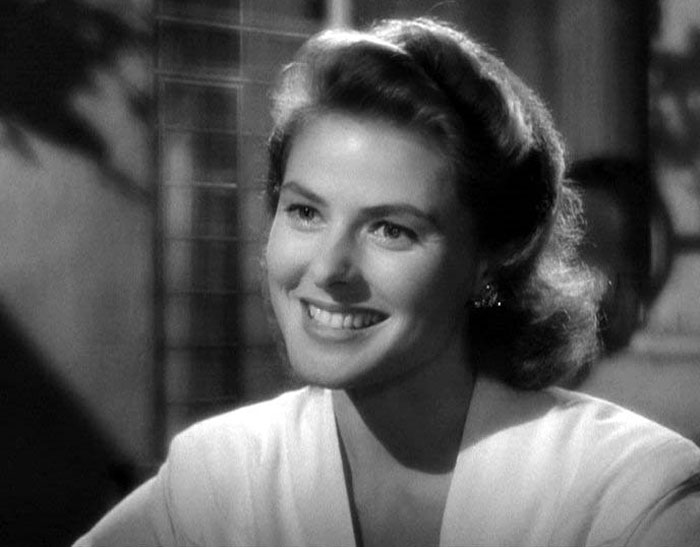
   Ingrid Bergman in "Casablanca." While not one of the three films that earned Ingrid an Oscar statuette, no one would deny that "Casablanca" gave her a classic part in a classic film. What's most interesting about her performance is that she had two men to whom she needed to show love for, but since the script was being written as they filmed, she had no idea which of the men her character really loved. So, she had to play most of her scenes ambiguously so that when it was finally decided she would go with one or the other (see the movie to find out who she ends up with,) the audience would not know that for the bulk of the shooting she had no idea who her character loved at all. Despite being so frustrated at this ridiculous work-condition, she played Ilsa Lund with great emotion and passion. Now, if you've already seen the film, go back and watch her scenes and try to figure out if she loves one man more than the other. I have my own thoughts, but that will be for another blog.

  As for more contemporary actresses, I would include the following females to my own hall of greatness, and some of the films I think are worth a look:

Sigourney Weaver for "Alien" and "Aliens."
Tilda Swinton  for "Michael Clayton" and her nearly unrecognizable cameo in "The Grand Budapest Hotel."
Helena Bonham Carter for "Fight Club" and "The King's Speech"
Charlize Theron for "Cider House Rules" and "Young Adult." 
Anna Kendrick for "Up In the Air" and "50/50."
and,
Jennifer Lawrence for "Silver Lining's Playbook"


   At some point, I will add more women to this list, but until then, check out some of the above actresses and see if you agree with my assessments or not. I'm thinking that you just might see something you hadn't seen before and come away impressed with these awesome talents as I have. 

Friday, February 13, 2015

Why I Love the Oscars Telecast


   How many Oscar telecasts have you watched from beginning to end? 

   Oh, I’m not talking about the endless, insipid pre-Oscars show where the media hang around like hungry rats along the red carpet holding microphones out and desperately trying to catch celebrities with shouts and pleas to give them a solid 90 seconds of camera time. 

   No. I consider that a pathetic circus that I avoid at all costs. I’m really talking about the moment the show begins, from the opening music, to the opening monologues, through each and every award and overly long speech, through each and every musical number, and watching every moment; good, bad, or awkward, until the telecast goes off the air.

   Anybody do that?

   Well, I do, and I’ve done that since before I can remember. I started watching back in the days when Bob Hope and Johnny Carson hosted the show to an audience at the Dorothy Chandler Pavilion in Los Angeles, a time when the Oscar host was so well-respected that no one dared criticize them in the Tuesday morning newspapers. (That’s right. The Oscars used to run on Monday nights.)

   Every year, I would count down the hours to a telecast that riveted me for three-plus hours because it was my once-a-year glimpse into a world I wanted to join. So, I would watch every category with my trusty Oscar ballot in my lap, for I would make my own Oscar predictions and see how well I did compared with the “experts.” Some years, I made friendly wagers on who could pick the most winners correctly. But more than anything, I just love the art-form of the motion picture so much that this one night, this one moment in time for me, is, dare I say it? 

   Magical.
   
   Oh, I know. Every year, we see fountains of verbal bile and vomit spewed onto websites by bitter reviewers who didn't like this joke, or that dress, or were offended by something someone said, or thought the telecast was way too long. 

   Me? I DON’T THINK IT’S LONG ENOUGH. 

   If the entire Super Bowl telecast, from pre-pre-game to pre-game to halftime to post-game can be between six and eight hours long, and NFL fans love that, I don’t see why movie fans can’t have a 4 hour ceremony. But I love it all because it’s LIVE, (it's the only major awards show that is ever shown live on the West Coast of the US,) and it’s all about the people who make the movies we love, and honoring the work of their colleagues. What’s not to love about that?

   I have always been honest about my love for the movie-making process, and the Academy Awards telecast is the one moment of the year where the best movies are awarded by the people who make the damn movies. This is no People’s Choice Awards, where the non-industry general public gets to vote. No. This is a private ceremony where ballots are only given to Academy members, members who can only vote on the category that employs them, as well as the Best Picture category. And we, the viewing public, get a mere glimpse into the world of cinema and get to share in the excitement of the ceremony.

   People say that the Oscars don’t reflect the opinions of the general movie-going audiences, and to that I say, DUH!

   What does the general public know about how to frame a shot? Are they better than a cinematographer to pick the Best Cinematography award? We know very little about special effects and what it takes to render shot after shot. Are we really qualified to vote on Best Visual Effects? No, we are not. Not unless we work in the industry, we don’t. It's better that the votes come from people who work in the industry, and not from someone who liked a movie because they think Charlize Theron is “hot.” (She is, but that’s beside the point.)

   It is ridiculous to argue that the Oscars are a waste of time because they never give awards to popular movies like “Fast and Furious” or “Magic Mike.” If you want to see the award for “Best Shirtless Performance, watch the MTV Movie Awards where the winners only show up when they know they've already won. For me, that’s not riveting. 

   What’s riveting to me is to see well-dressed celebrities sweating nervously like real human beings, reacting with a manufactured calm as their name is read out as a nominee, and then to see their reaction when they win (or lose) the award. This, to me, is also magical because it’s an honest, human reaction to a tremendous achievement.

   So, when you watch the Oscars coming up, (and I know you will because you are reading this,) watch the pre-Oscars show if it pleases you. Don’t let my aversion to that part of the telecast put you off. But above all, enjoy the moment. Imagine what it would be like to be a nominee, and cheer the people who made the movies you loved last year.

   Movies are a wonderful art-form, and the Oscars are the pinnacle of that art-form’s celebration of the very hard work they all did the previous year. 

   As a life-long movie aficionado, the only thing better than watching the Oscar telecast is to be sitting in a darkened movie theater and marveling at the artistry and craft employed by thousands to create a marvelous piece of filmmaking.

   After all, while it’s nice to see the ceremony, it’s the movies that make us care.

Thursday, February 12, 2015

SPOILERS: The Imitation Game - Secrets Sometimes Kill the Best of People


   As a boy, I was fascinated by codes and code-breakers. Our family had a copy of Clifford B. Hicks’ children’s book, “Alvin’s Secret Code,” where the main character, Alvin, was like Thomas Edison and Sherlock Holmes mashed together, but in kid form. “Alvin’s Secret Code” was part-story and part-instruction manual for how to write your very own coded messages, and it inspired me to learn more about codes, code-breaking, and cyphers. The book intrigued me so much that I would sometimes imagine myself being a super-spy sending messages that only my friends could read.

Unfortunately, my friends weren’t as interested in codes as I was, but this childhood memory flooded back to me as I sat to watch The Imitation Game, the story of Alan Turing, the mathematical genius and legendary cryptanalyst.

During the Second World War, an isolated mansion in the English Midlands known as Bletchley Park was actually a top secret facility where the smartest people in Britain were charged with the seemingly impossible task of breaking the codes Germany used to coordinate and communicate attack plans against Allied shipping convoys in the Atlantic Ocean during the war.

Alan Turing (portrayed with imaginative subtlety and restraint by Benedict Cumberbatch,) is an awkward, somewhat asocial character in the film. However, he has an extraordinary mind, preferring isolation to collaboration in order to get his work done. He begins working to build his own version of a Polish code-breaking machine, and he feels that his improvements will succeed in cracking those “unbreakable” German codes.

However, his lack of social graces and his request for solitude wins him no friends at Bletchley. The film shows his efforts to juggle the importance of maintaining social graces with his colleagues while simultaneously building the code-breaking machine that fewer and fewer people around him believe will actually work.

Joining him in this task is a woman at Bletchley named Joan Clarke, played by Keira Knightley. Clarke would become one of the very few female cryptanalysts at Bletchley Park during the war, and would also become one of Turing’s closest allies.

The central theme of the film is secrets. German secret codes are the lure, but not all secrets are the military kind, and Turing is hiding a whopper of a secret that, if discovered, would jeopardize not only his work at Bletchley, but his very life.

Alan Turing was hiding in plain sight as a homosexual in an era when Great Britain criminalized and punished such behavior without pity. This threat of discovery hung over Turing’s head like kind of Sword of Damocles waiting to come crashing down upon him and destroy everything he had worked for. As brilliant as he was, one mistake and everything would be ruined.

   The film is split into three sections: First, there are the scenes at Bletchley. Second, there is one detective’s investigation into Turing’s life after the war. And finally, there is a series of flashbacks that shows Turing at school as a young boy. The film jumps back and forth between each setting so seamlessly that it is no surprise that the film is nominated for this year’s Best Editing Oscar Award.

   Benedict Cumberbatch plays Alan Turing as a kind of suffering genius, although we know that it isn’t just his intellect that makes him suffer. Turing was never allowed to be free about his sexuality, which might have partially fueled his desire to be left alone in his work. It’s a given that this performance would have earned Cumberbatch a Best Actor Oscar nomination, as there is depth and humanity in his performance that warrants recognition.

   Keira Knightley is also worthy of her Oscar nomination for Best Supporting Actress as the confident, concerned friend and colleague, Joan Clarke. Her performance is self-assured, and she works very well with Cumberbatch, particularly during one scene where Clarke visits Turing after his indecency trial. It was a thrill to see Cumberbatch and Knightley hitting the emotional high points of their characters so that we really feel their struggles. 

The Imitation Game is such an entertaining and enlightening story, both about the triumph of Turing’s work as a code breaker and also the pain of his personal secrets, that any future attempts at portraying Alan Turing’s complicated life will have to meet the very high standards set with this film. 

Friday, February 6, 2015

Movie Review: Jupiter Ascending


When the Wachowskis set out to make a movie, you know it’s not going to be a simple film. After they blew our collective minds with the original Matrix film in 1999, and then disappointed the bulk of moviegoers with the remaining Matrix Trilogy, the Wachowskis have still wowed us with visuals that have no equal in the Hollywood realm.

After the Matrix films, the Wachowskis, Lana and Andy, chose their follow-up by writing and producing “V for Vendetta.” But their directorial follow-up was the amazing visual treat, but box-office bomb that was “Speed Racer.” While its visuals were amazing, anyone interested in a cohesive plot was disappointed. Then, they joined up with German “Run Lola Run” director, Tom Tykwer to co-direct the epically complex (and rumored to be unfilmable) book adaptation of “Cloud Atlas.” What resulted was a somewhat admirably ambitious exercise in both acting and plot. It was another dazzlingly visual spectacle, but another ultimately unsatisfying story adaptation, possibly proving that “Cloud Atlas” was best left on the written page.  

At this point, one wondered if their Matrix success was just a one-off, or if the Wachowskis were doomed with Orson Welles Disease, that unfortunate affliction where a director pops off a superior early effort (Citizen Kane) and never comes close to topping that early effort. The collective question about the Wachowskis has been, has their time run out?

I’d like to say it hasn’t. Jupiter Ascending, while not anywhere close to the visceral pleasures that they offered in The Matrix, is a game effort, and about as close to the ambition and epic scope that filmgoers hoped to see from this genre-innovating duo. However, it is still not an improvement in the areas of plotting, pace, and story, that make movies more than just a visual feast.

The film focuses on a Russian-American named Jupiter Jones (played by Ukranian-American, Mila Kunis, who drops some of her first language in the film very realistically,) whose father was killed when she was a baby. Jupiter is a young adult now living in Chicago with her mother and other Russian relatives and working as a toilet-scrubber and general housecleaner. This is not the life her mother wanted for her.

Suddenly, through a complex series of events, Jupiter is hunted for reasons that if one were not paying close attention, would become very confusing very fast, and she is saved from certain death by a male warrior with flying boots named Caine Wise, played by a hunky Channing Tatum wearing something akin to Spock ears. Jupiter is whisked away and informed that she is much more important than she ever dreamed. To go into the exact details of her importance would be revealing too much of the plot, but she becomes wanted by several factions. Some want to protect her, and others want to destroy her.

In another galaxy far, far away, unbeknownst to Jupiter, plans are being laid for her ultimate destruction by a powerful galactic family with machinations not unfamiliar to anyone who watches “Game of Thrones,” and soon, both Jupiter and Caine are under heavy attack.

What ensues is a grand series of action sequences, shaky alliances, trustworthy friends, outrageous betrayals, and the like, where we must weave our way through an anime-like plot complexity of strange names and unclear motivations to figure out who or what is behind the scheming and why we should really care.

I found the plot at times a chore to follow, but I feel I did reasonably well considering all of the bombast of the film and the spray of alien names and situations thrown our way. Mark my words: Anyone going into the theater to see this should be forewarned not to distract themselves with popcorn or a sip of soda for fear of missing something crucial to the story. If I had missed something of the plot along the way, I think I would have been lost and not enjoyed it for what it offers.

What it does offer is yet another visual spectacle of action sequences, fight scenes, alien settings, and wonderful visuals. Clearly, the Wachowskis love their FX departments. But the film still lacks the kind of clearly focused storytelling to match the ambition of the visuals. It’s another “fish-out-of-water” story and a story of a “chosen one,” both elements that are told much better in the first Matrix film.

Jupiter Ascending wants to be so complex and challenging that its story arc is dizzying, its plot twists are weak and unconvincing, and it’s far too much action and visual intensity, and not nearly enough character-based or emotional complexity for me to recommend this to everyone.


The Wachowskis appear to want to make films that are heavily reliant on special effects, but they fail to see why The Matrix was such a success. That plot was very simple to understand, the villains were easy to identify, and the twists were satisfying. The directing pair, while remaining excellent visual directors, has yet to give us the same combination of complex visuals and story combined.

I would recommend Jupiter Ascending if you love visual spectacles, and for that, I definitely recommend IMAX 3D for this film. But if you want a great story, this is movie is a disappointment.