Friday, February 12, 2016

Movie Review: Deadpool (Minor Spoilers)


Origins of a Movie Merc

"Deadpool," starring Ryan Reynolds as the "Merc With a Mouth," is a project that has been years in the making. This is Reynolds's second shot at Deadpool, since his first shot at playing the immortal, psychopathic mercenary, was in the 2009 film, "X-Men Origins: Wolverine." However, the realization of that film's character was an extreme disappointment to Deadpool fans, as it changed his back-story, and changed his entire look. Back then, due to this great disappointment, everyone feared that a Deadpool solo feature would never be made. And for five long years, fans would have to wait.

The "Leaked" Deadpool Video

Then, in 2014, a six-minute, "proof of concept" video was "leaked" onto the Internet (possibly by Ryan Reynolds himself,) featuring an exciting action sequence, along with Ryan Reynolds' voice talent. The video was apparently made by an effects company to prove that a Deadpool film can work, in the hopes that 20th Century Fox, who owned the film rights, would green-light a Deadpool film. Reynolds voiced the character in the same profane, violent, and extremely funny character that comic book fans have come to know and love, and it made the collective internet soil its Underoos with joy. If only, they all sobbed, the powers-that-be would understand that an R-rated Deadpool movie would actually make money, then maybe this film would get made.


Shortly after fanboys and fangirls lost their collective minds over this "leaked" footage, 20th Century Fox green-lit the film to every fan's delight. The thought among comic book aficionados was that this was Ryan Reynolds' opportunity to do two things: 1) Redeem himself for bad superhero movies, such as "Blade III," the Wolverine film, and especially, "Green Lantern." Ryan seemed to be liked as Deadpool, and only as Deadpool. So, this was his chance to shine. And 2) Deadpool fans could finally see a true-to-the-comic version of the Deadpool character, in live-action onscreen. 

So, Is It Any Good?

YES. It is a solid hit! (Someone please blurb me. BLURB ME!) "Deadpool" is a lean, mean one-hour and forty-eight minute assault on the senses and the funny bone, and it barely lets you rest before the next joke or action sequence. Even the opening credits are hilarious, providing one of the most inventive openings in modern superhero cinema, where the cast is described in a very unorthodox way. This is a movie that you must pay attention to or you will miss many a joke.

Okay. What's It About?

The film follows a Canadian mercenary for hire, named Wade Wilson, whose main source of revenue appears to be intimidating young men into not harassing females on a college campus. We see that he's not the most scrupulous man, and that he has killed people in combat, but he's also not working for the mob, either. So, points for Wade? Then, he meets Vanessa, a prostitute with a heart for bad-ass mercenaries named "Wade Wilson," and they have a storybook romance.

What? Is This a Rom-Com?

No, you annoying sub-heading. This is not a rom-com, so reality hits back at Wade and hits him hard with a cancer diagnosis. Quite honestly, there was a moment in the doctor's office where Wade is deep in thought, and this reviewer actually had a tear in his eye for a moment. 

Coincidentally, (or not,) Wade meets a man in a suit who offers to make Wade "better than better," and thus begins Wade's attempt to cure himself of his cancer, which, of course, goes horribly wrong, leaving Wade's skin horrifically disfigured, but with an unlimited healing factor. Yes. That means Wade is a physically scarred, immortal man. He cannot be killed. But being a horribly disfigured man means he cannot show himself to his main squeeze, Vanessa, who he left to be on her own in order to get the "treatment." Now, Wade seeks the man who gave him the treatment in order to force him to restore his previous good looks, He makes a suit, kills a bunch of people for information, and his pathway is cleared to finish the treatment, and kill all the bad guys in the end.

Why Is He Talking Directly To Me?

Fans of the comic know that Deadpool has always known that he is a fictitious character. It was Marvel's way to send up the superhero genre with a self-reverential comic book character who broke the "fourth wall" and talked straight to the reader. In this film, Deadpool knows that he's a character in a movie, and he frequently talks to the audience. In one scene, he's talking to the camera, but when another character answers him, Deadpool says he wasn't talking to him, but to us, the moviegoers. This is just one of the more fun aspects of the movie. At any point, the movie seems to take a complete u-turn, or it goes on a hilarious tangent that references some inside joke only the audience is in on.

Is It Violent and Sexual?

Yes, and YES. Hoo hoo boy, is it ever! The movie is chock full of gun-play, and while there is blood, it's almost cartoonish in its outlandishness, and not nearly as disgusting as an R-rating would have you believe. (Unless you get squeamish at the sight of any blood on screen, I think you'll be fine.) There is male and female nudity, and a couple tastefully shot sex scenes. The language is definitely more adult, and the jokes are mostly of a sexual nature. I fully expected more potty humor, but it seemed to stick with more sex-themed humor.

Is The Plot Thin?

The plot is sparse and uncomplicated, but that's a good thing. The movie is boiled down to this: Boy meets girl. Boy gets cancer. Boy leaves girl to get cancer cure. Boy's cancer cure severely disfigures him. Girl is kidnapped by bad guy. Boy must kill a mountain of people to battle for the love of his life.

That about sums up the plot. The jewel in the "Deadpool" crown is its complete reveling in its profanity and violence, like kids playing on the most awesome playground. You can tell that Ryan Reynolds is having a ball playing Deadpool, and it's easily his best superhero turn, even if Deadpool isn't exactly a superhero. He's an anti-hero who is amoral enough to not mind killing anyone to save his girl. Also, Deadpool gets some help from two members of a certain school for mutants, namely Colossus, and "Negasonic Teenage Warhead," who is as bad-ass as the name implies. She deserves way more screen time in the future.

Alright. So, Boil It Down For Me.

This is a thoroughly enjoyable, adult romp into a unique, blood-splattered world inhabited by an entertaining, motor-mouth, immortal mercenary whose humor is as relentless as his killing skills. It will please practically any Deadpool fan.

This movie is rated R, for language, adult situations, graphic nudity, and graphic violence, although I must say that I have seen movies where the violence is much more graphic, and the nudity much more pervasive. Nonetheless, be forewarned that this is an adult movie, and judge accordingly whether your kids are mature enough for this movie.    

Sounds Good. Is There a Marvel Post-Credits Scene?

Yes, and you must not miss it. Older moviegoers will understand the scene more than younger fans, but it's hilarious and informative, nonetheless.

Friday, December 18, 2015

Movie Review: Star Wars: The Force Awakens (NO MAJOR SPOILERS)


Note: I have pulled back severely from what I would normally reveal in this review because I know that people dislike Star Wars spoilers. Unfortunately, it is impossible to do a proper movie review without revealing some of the plot and characters, so enter with caution. I think I've written about the most un-spoilery review I could possibly manage, so don't worry. As with any review, you must determine on your own how much you care to know about the movie's details before you go to see it.

(If you DO want spoilers, I will be posting a no-holds barred review and analysis later.) 

Here now is my short, non-spoilery review of "Star Wars: The Force Awakens." 
____________________________________

You can all relax. J.J. Abrams gave us the movie we all wanted to see. He gave us a great, entertaining film, complete with action, comedy, and even emotion. But several years ago, this all seemed very unlikely.

Back when J.J. Abrams was announced as the director of the first film in a brand new set of Star Wars films, there was a bit of skepticism in sci-fi fandom. After all, Abrams did oversee the reboot of another beloved sci-fi franchise, Star Trek, and some fans were none-too-pleased with the result. 

With Star Trek, Abrams effectively erased the past, making anything that happened in the TV shows or movies null and void. So, fans feared that Abrams would be doing the same with their beloved Star Wars.

Well, fear not, Star Warsians, because this has not happened. The new film, "Star Wars: The Force Awakens," is a robust and exciting, sci-fi fantasy film that honors the past while setting up a promising future for the franchise. 

In the film's classic opening crawl, we are told of the disappearance of an important figure and two factions who are seeking to learn this person's whereabouts. This sets the scene for the action to follow. Once the action commences, the pain and suffering begins.

For you see, there is a new group of bad guys who look really similar to the old bad guys. The new version of the Imperial Empire is the ruthless, First Order. They have a new dark lord, a new gaggle of fanatical officers, and a plan to wipe out all that is left of the Resistance, once and for all.

With a nod to the original Star Wars, much of the early action centers around a desert planet called Jakku, and a young female scavenger named Rey. She is self-sufficient, independent, and hard-working, but her work pays little, and her gaze occasionally drifts to the starships she sees leaving the planet. 

However, she comes across a lost droid named BB-8, a spherical robot with a head that always stays parallel to the ground as it rolls. Soon after, Rey meets a mysterious man named Finn, and before the three of them realize it, the First Order is trying to gun them all down. 

It seems that the droid possesses something that the First Order wants very badly. More importantly, one dark lord wants it very badly - a black masked, black cloaked figure named Kylo Ren. Ren is a Force-wielding killer, and he will stop at nothing to obtain what the droid is carrying. He also has an agenda that would make the late Emperor Palpatine very proud. 

If this feels somewhat familiar, that's half the point of this film. It is part nostalgia, part new adventure, and it all flows quite nicely with each other. We get to see old friends again, like Han Solo (Harrison Ford,) Chewbacca (Peter Mayhew,) Leia (Carrie Fisher,) and others. The addition of solid new characters like Rey (Daisy Ridley,) Finn (John Boyega,) and X-Wing pilot Poe Dameron (Oscar Isaac,) all feel like the franchise is heading in a very interesting, emotional direction similar to the original trilogy.

"Star Wars: The Force Awakens" has everything a die-hard Star Wars fan could possibly want. You'll care about the new characters just as we cared about the older ones when we first saw them, and that's crucial for the longevity of the series. The film has The Force, cool spaceships, big explosions, strange aliens, droids, interesting vehicles, lightsabers, surprises, intrigue... and it has "adventure and excitement." While a Jedi should not crave these things, Star Wars fans do, and J.J. Abrams successfully delivers to them a very worthy addition to the Star Wars universe that they will not be embarrassed to talk about 10 years from now.

Postscript: If you think this gives anything away, I can assure you that I have not mentioned hardly anything about this film. You can go to the theater safe in the knowledge that you have a starting point for an entertaining experience, but one that will still surprise and delight you.

Monday, March 2, 2015

Movie Review: Kingsman


Who doesn’t like a good spy film?

If you raised your hand (either figuratively or literally,) after reading that last sentence, then Kingsman: The Secret Service is definitely not for you. For the rest of us, Kingsman is both a highly charged and self-aware compliment to the spy films of past and present (not unlike the way Scream was a knowing compliment to all of the horror films it referenced,) while attempting to carve out its own small niche in the spy genre itself. 

In this humble reviewer’s opinion, the film achieves the former, but never achieves the latter.

Kingsman is a loose adaptation of a Mark Millar (Kick Ass) and Dave Gibbons (Watchman) comic book titled, The Secret Service that was first published in 2012. In this filmed version, Colin Firth plays Harry Hart, a covert operative whose protégé is killed in the line of duty. Harry later hands a medal of bravery to the son of his protégé along with a phone number and coded phrase if he or his mother ever needed assistance.

Seventeen years later, the boy, Garry “Eggsy” Unwin (played  by relative newcomer, Taron Egerton) is a young man without direction and living with his mother and her abusive boyfriend. Eggsy is arrested for stealing a car, and he uses his one phone call to dial the number on the back of the medal. After saying the code-phrase, Eggsy is immediately released from jail without explanation. Outside the police station, Eggsy meets Harry, the man who gave him the medal so long ago, and Eggsy soon discovers that his father was a part of a secret organization of spies called “Kingsmen,” and is offered an opportunity to become his new protégé.

What follows is a classic comic book origin story as we follow Eggsy’s training into the world of spies. While this happens, the Kingsmen are busy investigating a man named Valentine, played by the always amazing, Samuel L. Jackson, who might be responsible for a series of high-profile people suddenly disappearing around the globe. Soon, Harry Hart, Eggsy, and the Kingsmen must deal with a plot of worldwide significance that deals with the manipulation of technology for a nefarious end.

Kingsman: The Secret Service is a movie that is aware of the spy films that preceded it. It’s so reverential to these films that, in one scene, a character even names some of the most famous spies in popular culture as a none-too-subtle tip of the hat to the genre. This reverence for the genre is never far from our sight, as the winking and nodding almost becomes the point of the plot.

This is the film’s biggest flaw. Any movie that is constantly winking at us and saying “Did you catch that reference?” can get tiresome after a while and make us wonder when the film’s own unique voice will begin. 

Sadly, it never does. There is a point where the winking and the nudging goes on for a bit too long, and this reviewer wished it could have been toned down to allow for its own voice to shine through. It is one thing to be reverential of the spy genre, but entirely another to make that reverence a constant part of the story. It’s like the film constantly taps you on the shoulder to remind you of the genre it’s sending up, and that became a tedious and annoying reminder.

Since the nods to the spy genre never end, the film never really transcends the genre that it clearly loves, and thus, never succeeds in forging its own identity.

One cannot watch this film without drawing comparisons to Mark Millar’s previous comic book adaptation to film, Wanted, starring James McAvoy, Angelina Jolie, and Morgan Freeman. Wanted has the exact “normal-guy-joins-secret-society” plot as Kingsman, but with slight variations, and there is a sense that this has all been seen before many times.

Despite being the “wink-wink-nudge-nudge” fest that it is, Kingsman does deliver some really cool moments, including some awesome action sequences with Colin Firth. He dispatches foes with the style and ease of a man calmly pouring a cup of tea between trigger-pulls and knife-stabbings, making sure never to muss up his perfectly tailored, Savile Row suit in the process. The violence is fast and frequent, providing an appropriate amount of menace to the story. Yet, there are a few intentionally muted scenes that tone the violence down using a bit of surrealism, but make no mistake; it’s still an “R” rated film.

If you liked Wanted, you’ll probably find Kingsman to be a better film, but you will see the similarities immediately. If you love the spy genre, and you just want to sink back into that world as seen by some “super-fan” filmmakers, then Kingsman will entertain you, and it's definitely worth your time. However, if you want something that is wholly original, taking the spy genre into new levels of excitement and creativity, Kingsman will probably be a disappointment to you.

Saturday, February 28, 2015

Movie Review: Birdman


Many people suffer from “negative self-talk,” which is a critical voice in their heads that says things like, “Why try out for the football team when you know you’re a loser?” Or, “You’ll never be a Class-A musician, so just give up your dream.” Or, “Your acting is horrible and the only one who doesn’t know this is you.”

This kind of “negative self-talk” is one of the central themes in Birdman, or (The Unexpected Virtue of Ignorance), starring Michael Keaton, Emma Stone, Edward Norton, Zach Galifianakis, and Naomi Watts. The film won this year’s Academy Award for Best Picture. 

In Birdman, Michael Keaton plays a man named Riggan Thomson, a washed-up film actor famous for playing a superhero (Birdman) in a series of very successful films many years ago. Riggan is shown attempting an ambitious comeback to write, direct, and star in his first play on Broadway, and it is not going the way he expected.

His daughter is unhappy as his personal assistant, he has production and public relations problems, he has girlfriend problems, but his main antagonist is actually Birdman himself. Riggan hears the near constant, droning voice of Birdman telling him that he is wasting his time and that he should give up this Broadway nonsense and come back to the superhero role that made him a star. The film examines Riggan’s near-crippling self-doubt, it satirizes the Broadway theater culture, and it features the desperation and hope of actors who just want to say, “I acted on a Broadway stage.”

While Birdman could have been filmed conventionally, the filmmakers chose the more difficult path. Similar to Alfred Hitchcock’s movie, Rope, Birdman is shot as if it was mostly one take. The camera follows characters up and down stairs, all around the stage where the play will take place, on the streets outside, up on rooftops and back again, and it’s all very impressive and seamlessly done. One of the joys in this film is to figure out where the edits are located. I assure you, it’s not as easy as it is to spot in Rope.

Best Director Oscar winner, Alejandro G. Iñárritu, and Best Cinematography Oscar winner, Emmanuel Lubezki required the cast and crew to film very long scenes without error. This involved many rehearsals since some scenes were up to fifteen minutes in length. It required a constantly moving camera, multiple settings, multiple actors, tons of flawlessly performed dialogue, and every actor and every crew person had to hit their marks perfectly, or they had to start the entire scene over again. 

It’s this combination of acting excellence and technical prowess that impressed the Academy enough to give it their highest award.

Michael Keaton is simply superb as a tortured Riggan, who we see slowly descending into madness. This really is a monumental acting performance by Keaton, as he is in most of the film’s scenes, and he is believable throughout. You can feel that this might be his character’s last shot at attaining whatever he thinks is “success,” and he sees it slowly slipping away from him. Watching Keaton’s journey through this movie, even without the technically complex element, was a truly fun experience.

Edward Norton’s role as a Broadway veteran named “Shiner” is also a standout performance. Norton plays the character with uncommon levels of confidence, but we see brief glimpses that this might be a carefully crafted facade. Other noteworthy actors in the film are Emma Stone and Naomi Watts, as Riggan’s daughter and one of the play’s stars, respectively.

Birdman was impressive on a number of levels. It has awesome acting, a great script, technical excellence, and it’s about the inner-workings of the acting profession, which the Academy always loves. So, it makes perfect sense to award Birdman with Best Picture.

While I can’t say that Birdman would have been my vote for Best Picture, it’s clearly a film-making achievement worthy of the top award because the filmmakers dared to take the more difficult path to make a good movie great, and it succeeded to produce a really amazing film experience. It’s a movie that film students will be studying for many years to come, and I can’t truly say that about all of this year’s Oscar nominees.

Friday, February 27, 2015

Leonard Nimoy Was More Than Spock To Me


   Let me take you back to a childhood. My childhood, in fact. 

   It's the early 70s, and Star Trek, the seminal TV series that spawned the sci-fi convention business that we all take for granted today, had been off the air for only a few years. These were the years when Trek was in syndication and we could see maybe two episodes every week, or sometimes an episode every weekday. 

   In 1974, I looked at the paper's TV listings and saw that there was a new Star Trek cartoon series starting in the fall. By then, Leonard Nimoy had already started doing his series seeking answers on the unexplained called In Search Of. So, in those early years of my life, I got to see Leonard Nimoy on television a lot. 

   You could say that the sound of Nimoy's voice is as important to me as the sound of a heartbeat, or the soothing voice of my mother, and possibly even the voice of Hall of Fame baseball announcer of the Los Angeles Dodgers, Vin Scully. 

   Nimoy's presence in my life was so frequent, that he was more than an actor or a narrator to me. He was a guide. He steered me toward logical thinking as Spock, he steered the Enterprise out of danger, and as a film director on several Trek films, he steered our hearts into bigger and better cinematic experiences.

   Leonard Nimoy's Spock character became as iconic in the 60s and 70s as the most well-known faces in pop culture. And while there was a time when he disliked his association with just this one character, he later embraced it, as fans of his work always did. 

   Many years after my initial obsession with Star Trek began, I had the privilege of seeing Leonard Nimoy speak to an audience of very dedicated fans at a Star Trek convention in the early 90s. By then, Nimoy had been doing conventions on and off for around twenty years, but he was always engaging, always funny, and I had never seen a convention crowd get so excited to see a Trek cast member. It was like he embodied everything we liked about the show. If there was a way to tap into the energy in that room and convert it to electricity, it would have been able to power a small city. (At least, a fleet of Priuses. Or, is the plural of Prius, "Prii," as in "pree-EYE?")

   I don't have any autograph or photo of him, as that is not my thing, but I have his image in my memory from that night, and I can recall the image of him standing on the convention stage whenever I want. I just can't show anyone, and that's okay. That's okay.

   More than anything else, I respected Nimoy in anything he did because he was able to use his deep voice and his superior acting skills to make the part his own. Star Trek took up the bulk of his professional life, but he did many non-Trek shows, cartoons, plays, and projects that didn't need him to glue on fake ears and shave part of his eyebrows to work. I hope people will spend the time to look at some of his non-Trek work to see his range of talents.

   Nimoy wanted to be known for more than just one role, and while that goal was not realistically possible, it didn't stop him from being a very prolific actor, writer, and director.

   His voice is now silenced, like that of many others from my childhood, but I can always hear it in a TV episode, or a radio play, or in a TV interview. His voice is recorded for all time, and for that, I am thankful.

   I think it's fitting that this tribute end with probably my favorite quote so far on the passing of this wonderful man. It's from fellow Star Trek cast member and friend, George Takei:

"The word extraordinary is often overused, but I think it's really appropriate for Leonard. He was an extraordinarily talented man, but he was also a very decent human being."

   Rest in Peace, Leonard Nimoy. You left the world better than when you entered it. 

Sunday, February 22, 2015

2015 Post Oscars Report


The 2015 Oscar Awards has ended, and this is my after-Oscar report.

J.K. Simmons, for Whiplash, was the only award that demanded an Oscar award, and he won it. The fact that he implored people to call their parents, was one of the more emotional moments for me during the ceremony.

It was nice to see Interstellar win for Best Visual Effects. It definitely earned that award.

I was totally surprised at how many awards that The Grand Budapest Hotel was winning considering how many movies were predicted for wins that did not include The Grand Budapest Hotel in the title.

Also surprised at Birdman receiving Best Picture only since I haven't seen it yet. Now is the time where I see it and figure out if I agree with the Academy.

Honestly, I felt that the best film of the year was The Grand Budapest Hotel in every way, but since I haven't seen Birdman, it's difficult for me to agree or disagree with the vote.

The show was fun, filled with good jokes from Neil Patrick Harris, and it only went over time by a half an hour or so, but I've never cared about that.

Common and John Legend's performance of the Oscar winning song for Selma called "Glory" was a real crowd pleaser.

Honestly however, this year was a weak year for films if we are to compare them to other eras. Birdman is a film I cannot critique myself, but the bulk of films released this year did not captivate me like in previous years. While I loved The Grand Budapest Hotel, and I felt it was the best in the field, this group of Oscar contenders did not equal the films of other years.

However, I will have to see Birdman to see how close to perfection I think they came with this Best Picture award.

At this point, I am not sure.

Monday, February 16, 2015

These Are The Women (On Screen) That I Love


   I took a look at this year's Best Actress nominees for the Oscars, and I was surprised and a little bit embarrassed to discover that I had not seen any of their performances. Not only that, but I was shocked to learn that none of the actresses were nominated for films who were vying for the Best Picture category. Simple extrapolation from this shows that the eight Best Picture nominees focus almost entirely on men. (Or, as in "Boyhood," a boy, a teen, and then, a young man.)

   It made me wonder why this is, and I didn't have the answer. So, instead of pointing fingers at Hollywood executives or railing against a male-dominated film industry, I decided to list some of my favorite actresses of all time as a way of celebrating great women in the acting profession. I list four female actors from the Golden Age of Cinema since I have an affinity for this period. At some point, I will do a Take Two segment and focus on other eras and more women deserving of recognition. 

While the women I list are not all Oscar winners, all of them gave memorable performances in very different films.

   So, here a short list of my favorite actresses from the golden age of cinema, in no particular order of greatness:


  Greta Garbo in "Ninotchka." Simply unforgettable. One of her final films before she quit the business for good, Garbo shines as a Soviet envoy who falls for Melvyn Douglas and tastes the delights of Paris that are frowned upon in her communist country. We see her trademark Garbo seriousness, but we also see her struggle with love and even happiness, concepts that she is unfamiliar with, and it's a delight to watch Garbo act them out. It must be added that posters for this film advertised that "Garbo Laughs!" as a none-too-subtle reference to the public perception that Greta Garbo never smiled or laughed in her movies. This was not so, but never let the truth get in the way of a good ad campaign. She would make only one more movie after this, and then quit to live in seclusion. In a way, it's sad that such a great talent chose to end her career so early, but it adds to her mystique, and her considerable body of work stands as a great gift to film fans, even today.  


   Another actress worthy of note whose initials are "G.G." is Greer Garson in "Pride and Prejudice." While this adaptation of the Jane Austen novel takes certain liberties with the book, there is no other version of Elizabeth Bennet that matches Garson's in my mind. She is equal parts coy, smartly indignant, and both repulsed by and attracted to Mr. Darcy. This may not be Garson's most famous role, (which would probably be "Mrs. Miniver" two years later in which she won the Oscar for Best Actress,) but it is the one I can watch over and over again.


   Joan Crawford in "Grand Hotel." This is one of the very first Hollywood films with an "all-star" cast, as it had Crawford, Greta Garbo, Wallace Beery, and both John and Lionel Barrymore, all of whom were silent film legends at the time, and Crawford had only third-billing, behind Garbo and John Barrymore. (I would have also mentioned this as a Greta Garbo highlight, as it's another gem in her all too short filmography.) To me, "Grand Hotel" is my favorite film that includes Joan Crawford. As the stenographer in the story, she shows independence, a strong-mind, and a playful sexiness that audiences loved from her. In a sense, she is almost everything in the film that Garbo's character was not, as Garbo played a depressed ballerina. Crawford's character sees darker moments in the story, but her strength, level-headed manner, and ultimate kindness, make this film another that I can watch repeatedly without degradation. 


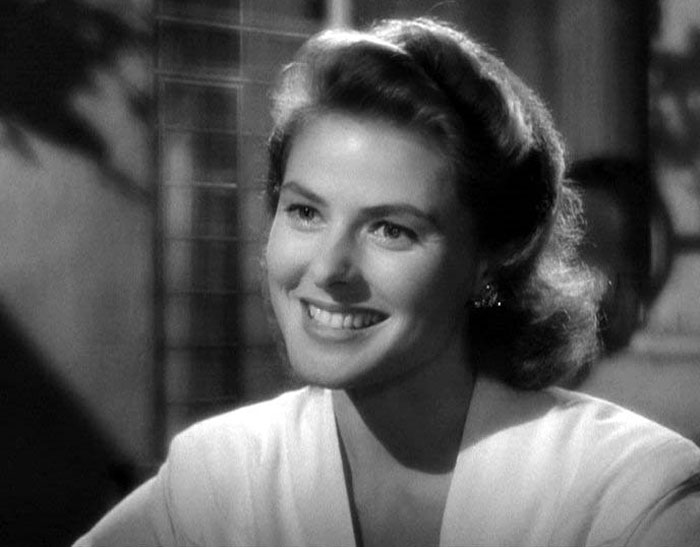
   Ingrid Bergman in "Casablanca." While not one of the three films that earned Ingrid an Oscar statuette, no one would deny that "Casablanca" gave her a classic part in a classic film. What's most interesting about her performance is that she had two men to whom she needed to show love for, but since the script was being written as they filmed, she had no idea which of the men her character really loved. So, she had to play most of her scenes ambiguously so that when it was finally decided she would go with one or the other (see the movie to find out who she ends up with,) the audience would not know that for the bulk of the shooting she had no idea who her character loved at all. Despite being so frustrated at this ridiculous work-condition, she played Ilsa Lund with great emotion and passion. Now, if you've already seen the film, go back and watch her scenes and try to figure out if she loves one man more than the other. I have my own thoughts, but that will be for another blog.

  As for more contemporary actresses, I would include the following females to my own hall of greatness, and some of the films I think are worth a look:

Sigourney Weaver for "Alien" and "Aliens."
Tilda Swinton  for "Michael Clayton" and her nearly unrecognizable cameo in "The Grand Budapest Hotel."
Helena Bonham Carter for "Fight Club" and "The King's Speech"
Charlize Theron for "Cider House Rules" and "Young Adult." 
Anna Kendrick for "Up In the Air" and "50/50."
and,
Jennifer Lawrence for "Silver Lining's Playbook"


   At some point, I will add more women to this list, but until then, check out some of the above actresses and see if you agree with my assessments or not. I'm thinking that you just might see something you hadn't seen before and come away impressed with these awesome talents as I have.